

Astaxanthin is vital for us all in this aging process. Every blessing we can get for all round health and optimal function is a bonus. We are grateful for the bioavailable source. Regards Steve and Fiona
Fine at 9am.
Struggling by lunch.
Done by 3pm.
Your eyes are breaking down faster than they recover. Eye drops treat the surface. They can't reach the tissue inside your eye where it matters.

When did your eyes stop lasting the whole day?
You wake up and your eyes feel fine. Clear. Normal. Then the day happens.

Fine. Clear. Normal. You get to work.
A slight heaviness sets in. A dryness that wasn't there an hour ago. You blink hard a few times and keep working.
Your eyes feel gritty. The screen looks less sharp than it did at 9am. You reach for eye drops. They help for fifteen minutes. Then the dryness creeps back.
You're done. Your eyes ache behind the sockets. You look up and the room takes a second to come clear. You've still got hours of work left.
Headaches you never used to get are becoming routine. And here's the part that actually worries you: this is getting worse. A year ago it wasn't this bad. Two years ago you barely noticed it. Now it starts earlier in the day, takes longer to recover, and eye drops do less and less.
You've tried blue light glasses. You've adjusted your screen brightness. You've been to the optometrist and been told your prescription is fine, your eyes are just "strained" or "dry." Take some lubricating drops. Come back next year.
None of it has fixed the underlying problem. Because the problem isn't on the surface of your eyes.
Two things break down when you stare at a screen all day.
This isn't about willpower, screen time apps, or taking more breaks. It's about what's physically happening inside your eye while you work.


Eye drops and blue light glasses work on the outside. The breakdown is happening inside.
The supplement that works from inside your eye.
In Japan, this was figured out twenty years ago. Most Kiwis haven't heard of it. Here's what it is and why it works.

Astaxanthin is what turns salmon pink. It's an antioxidant produced by microalgae, the tiny organisms at the base of the marine food chain. Salmon eat it, store it in their muscles, and burn through it during the gruelling swim upstream to spawn. Without it, they don't survive the journey.
Millions of people across Japan have taken it daily for the last twenty years. It's newer to New Zealand.
Peer-reviewed research measures astaxanthin's free-radical neutralising power at 6,000 times vitamin C. Not marketing. Actual antioxidant chemistry.
Your eyes generate more oxidative stress per hour of screen time than almost any other organ. That damage accumulates. It's part of the reason the problem gets worse year after year.
Astaxanthin has a specific affinity for eye tissue. It doesn't just circulate in your blood. It reaches the cells that need protection.
Relative free-medical
CLINICAL EVIDENCE IN SCREEN USERS
improvement in focusing ability after 4 weeks
significant reduction in eye strain symptoms.
improved tear film stability and tear production
Nagaki et al., 2010; Nagaki et al., 2002. Randomised, double-blind, placebo-controlled trials in VDT workers.
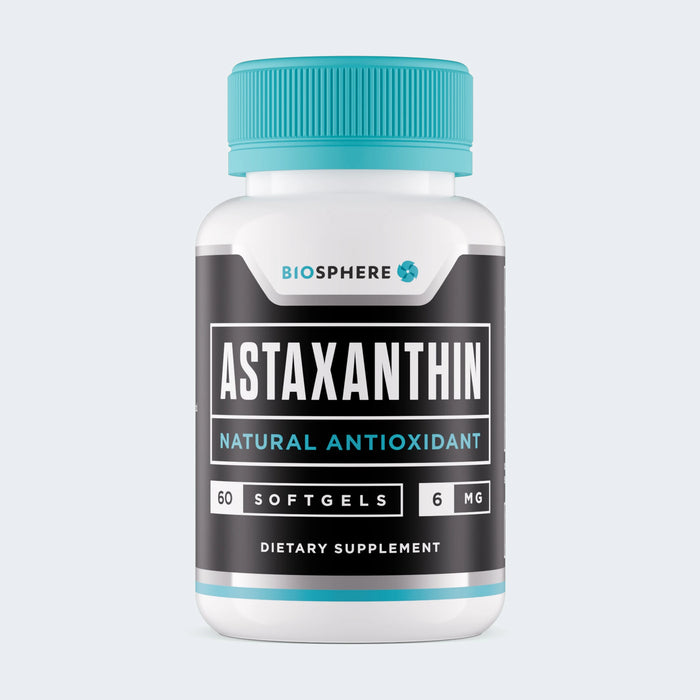
Published clinical studies used 4 to 9mg of astaxanthin daily. Biosphere delivers 12mg. That's above every dose that showed results in peer-reviewed trials. Not a token amount on a label. A therapeutic dose.
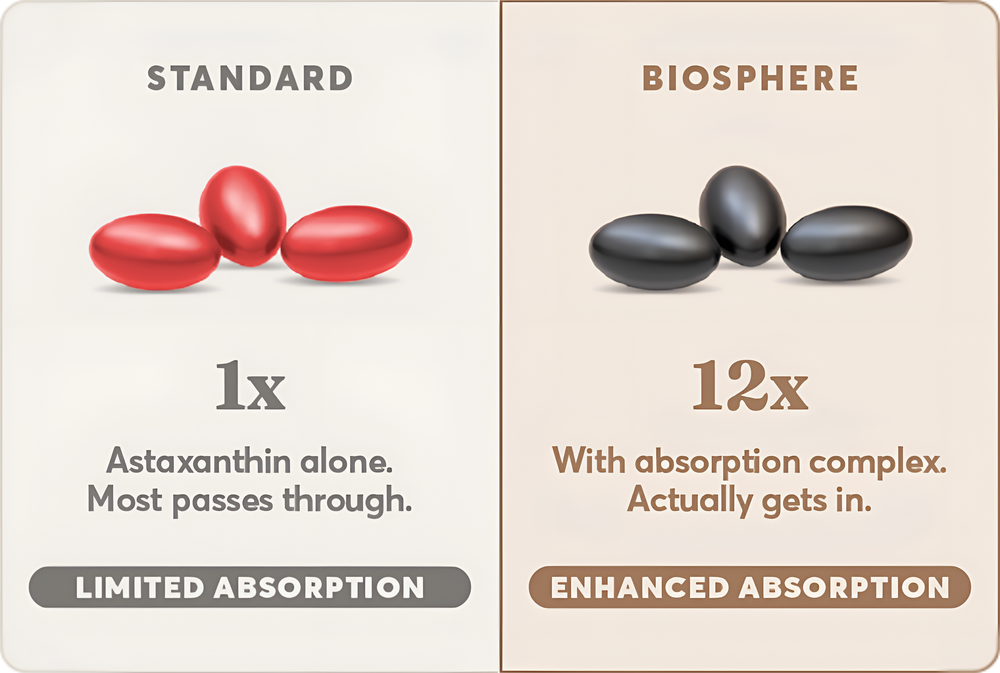
Astaxanthin is fat-soluble. A dry tablet delivers it without the fats needed for absorption. Each Biosphere softgel suspends it in olive oil with phosphatidylcholine, so it reaches your eyes, not just your digestive tract.
Two softgels with breakfast. That's it.
GET 20% OFF YOUR FIRST BOTTLE
About $1.20 per day.
Overall rating: 4.8 / 5 from 1681 reviews.
Astaxanthin is vital for us all in this aging process. Every blessing we can get for all round health and optimal function is a bonus. We are grateful for the bioavailable source. Regards Steve and Fiona

I have tried many supplements over the years. Some I’ve stopped using because I didn’t notice a difference. I Will always aim to keep astaxanthin as part of my stack. I have noticed such an amazing change in my skin. My skin has always been good, but this has taken it to another level. I love this product! I particularly love the Biosphere brand as they use olive oil in the capsules, rather than seed oils. Really happy to support this NZ company.

Great product, I have been using it to help my eyes feel more comfortable ( post menopause) , they are definitely less scratchy than they were! I can’t wait to try the magnesium yet, it looks really good.

We both have the best sleep usimg this product. I am about to put in another order.

Lovely flavour and works really well.

I rely on 'Sleep' to help my sleep. Its a vial part of my evening ritual. I notice when I dont take it

Great for dry eyes. Best I've tried

Take this every night for restless legs and sleep . Alternate between the 2 flavours

Very good product but I did have to adapt it. I found taking it just before bed it would give me a hit of energy. So I no take it with dinner or just after around 7 and it gives my body time to process the ashwaganda. I still do have trouble sleeping but I do feel the nights I do sleep it’s a deeper sleep. I am going through a lot of stress and biological changes but I do feel it has helped just not as much as I hoped. The flavour is delicious and the customer service was awesome. I’m going to try the plain magnesium next time as I think ashwagandha not well suited to me

Great product - slept soundly :)

I actually love the flavour! I have noticed an increase in energy levels. Highly recommend.

I’m loving this quality magnesium product from BioSphere as it has transformed the quality of my sleep.

I was sceptical but desperate when I started using Gut Support. After the first month, there hadn’t been a huge change, but I decided I was going to give it 2 months. Only a week into the second tub I noticed a definite change, and after not quite 2 months my system is so much calmer and more regular - the best it has been in nearly 6 years.

Nerve pain gone , deep sleeps after taking this . ! I am about to reorder , thanks guys 😍

This has been a game changer for me . It has eased pain and cramping at night . It promotes a feeling if calm and relaxation . I will never stop using this . Please buy it . I promise you won’t be sorry . Carolyn

Just love this product. I am on my third tin. I have been able to halve my blood pressure medication.

Sleep so much better and no more cramps

I won't need to ask for my money back. It works! The quality of my sleep has improved 10 fold.

Helps me stay asleep all night long

Prompt delivery and high quality. Noticed my eyesight not troubling me as much within a week.

It was a tough winter but this Biosphere Immune got us through.

I began taking this product 2 weeks ago to help with my sleep due to RLS and aching muscles due to injuries. Its great. I fall asleep well and sleep longer. I love the lemon lime flavour too!

Great quality astaxanthin and an easy addition to my daily supplement routine. I take it for its antioxidant, skin and general healthy-ageing benefits. Simple, well-dosed and no fuss. Very happy with it.

Awesome product!

Love it

Really like the flavour and taste, it encourages me to use it daily !

My husband and I have both been taking Biosphere Nitric Oxide, and we’ve been really happy with how we feel since starting it. We both feel so much better overall and have noticed a real difference in our general well-being and energy. It’s now become part of our daily routine, and based on our personal experience, we’re very pleased with it. It’s not often that we find a product that we both feel has made a noticeable difference, but this one has. We’ll definitely continue taking it!

Another one bites the dust! I’m really benefiting from taking this product every evening. I’m sleeping through the night, and waking refreshed. I would recommend this to anyone as a fuss free, easily digestible form of magnesium for settling your nervous system and allowing good sleep patterns.

Really like the Biosphere Magnesium. It's so helpful before and after hard physical work when I tend to get plagued with cramp. Alongside other salts & good hydration it's been great .Also very pleasant to drink. My wife also likes to use it at night for restless legs & to help relax. 😊

I love this product. I noticed an improvement in my skin. Looks and feels so much smoother.

I have systemic health issues and this is great for sleep, nerves and digestion (in a slow moving system). Great combination of types of magnesium. Easy to mix and take.

Great product. I take it every morning 🙂

Having parkinsons disease, exercise is very much my medication but has consequences the magnesium helps with the cramps and sleep quality which makes tomorrow better.

Love this product, after my first month I have far more mobility, energy and stamina, will be purchasing more...

I haven't gotten my very first bottle yet, but I will be ordering more. Capsules are easy to swallow, and makes it easy that need to take with food . Easy to remember with breakfast

It’s one of those things that you don’t you don’t know what you’ve got ‘til it’s gone! I was sleeping well and didn’t notice my gym recovery was good until I ran out of magnesium! Without it, my sleep is terrible and I’m sore for days after working out. Ordering more now!

On my second month of astaxanthin, not much change except a little more energy generally. Will give it a full three months.

I am so happy with my Astaxanthin . Can’t believe that it has worked so quick at pain relief . I have tried lots of other products in many years and I think this is the best thing I have tried . I have no pain and it so good . I hope this keeps up I have arthritis and and a few joint replacements so always in pain . Thank you

Awesome flavour magnesium for a massive day in the mountains!!!

Both flavours are nice and the powder mixes well. No longer getting night time cramps, so very happy with this. Will definitely be continuing with this product.
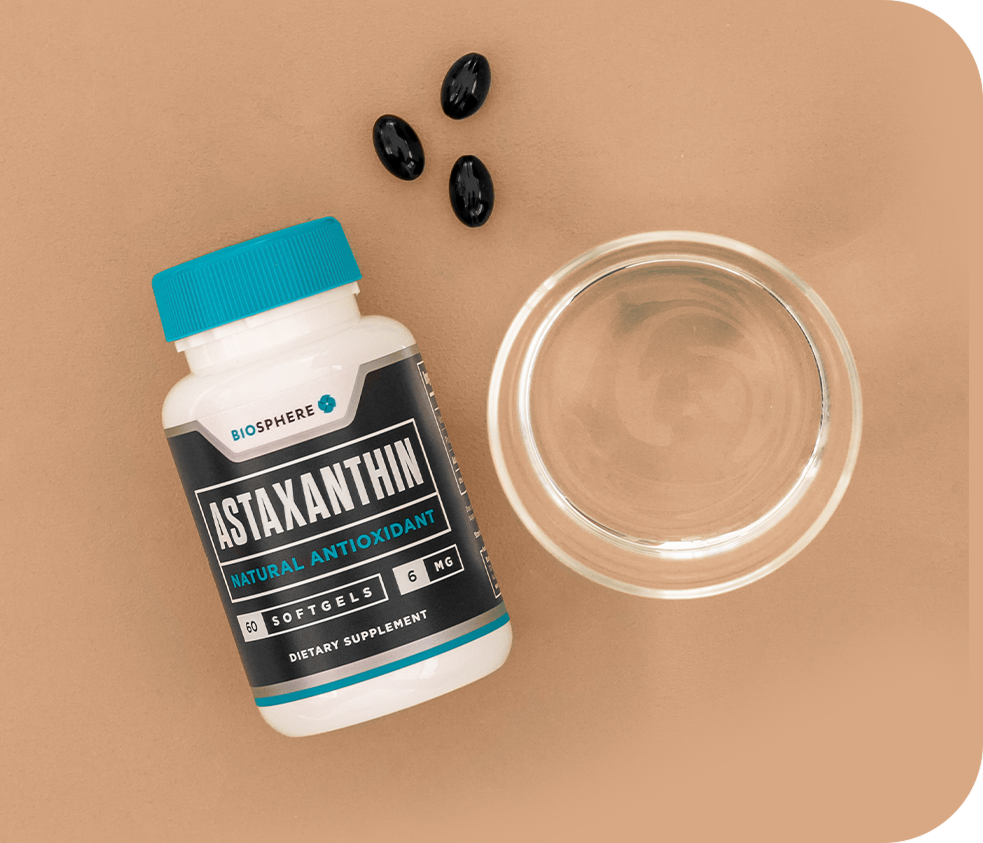
Two softgels with breakfast. The healthy fats in your morning meal help absorption naturally.

Trying something new takes trust. Especially when you've already spent money on eye drops that wear off and blue light glasses that didn't change much.
So we make it simple.
Clinical studies showed significant improvement in eye strain and focusing ability within 4 weeks. Some customers report less dryness in the first 1 to 2 weeks. Full benefit builds over time.
60-day money-back guarantee. Email us for a full refund. No questions, no hassle. You don't even need to return the bottle.
Clinical studies used 4 to 9mg. At two softgels daily, you're getting 12mg. That's above every published study dose. Being above the therapeutic threshold is the point.
Different target. Lutein accumulates in the macula (back of the eye) over 6 to 9 months. Astaxanthin deposits at the front of the eye where focus is controlled, and showed results in 4 weeks. They complement each other.
A naturally occurring antioxidant from microalgae. It's what gives salmon their pink colour. Published research ranks it among the most powerful antioxidants ever measured.
Most Kiwis haven't. Astaxanthin has been mainstream across Asia for decades. Japan alone accounts for roughly 25% of the global market. It's newer to New Zealand but growing fast.
Yes. Astaxanthin is well tolerated and safe to combine with most supplements. If you're on blood-thinning medication, check with your doctor first.
Yes. Astaxanthin is non-habit forming and does not build tolerance. Benefits are cumulative, meaning they improve over time. Many customers take it as part of their daily routine for months or years.
Astaxanthin extracted from microalgae using a solvent-free CO₂ process. Every batch independently third-party tested. Manufactured in a GMP-certified facility in West Auckland.
Remember what 3pm felt like today?
The heavy eyes. The blur.
The ache that builds through the afternoon and follows you home.
You can't reduce your screen time. But you can change what happens to your eyes during those hours. This is the same antioxidant millions of people across Japan have taken daily for twenty years, backed by multiple clinical trials in screen users.
Biosphere has been selling it in New Zealand since 2016.
Try it for 60 days. If your eyes don't feel different, you pay nothing.

