

Everything
creatine
actually does.
You've heard the name. Here's the full list, with the evidence behind each one.

 Memory & clarity
 Everyday energy
 Muscle strength
 Bone
Bone

The memory research was done on people her age.
The memory effect shows up strongest in older adults.
A meta-analysis pooled the randomised trials of creatine and memory in healthy people, then split the results by age.
In older adults the effect was clear. In the youngest participants there was none.
The benefits sit with people it was never sold to.

Everything we claim is printed on the label.
Memory, attention, and how fast you process things.
A second review pooled sixteen trials and found creatine improved all three.
Memory came out strongest, and it carries the highest confidence grade the researchers gave any cognitive outcome in the review.

Your cells keep an energy reserve. This is what fills it.
Creatine is stored in your muscles and your brain as phosphocreatine, the fast-access fuel your cells draw on to regenerate ATP, the energy they actually run on. You make about a gram a day yourself and get the rest from meat and fish, so your natural stores sit lower if you eat little red meat.
Both organs draw on the same system. That's why one molecule turns up in research on muscle and research on the brain, and it's the reason this page has as many sections as it does.
Same reserve. Two organs that depend on it.

Some mornings start with less in the tank than others.
The tank matters most on the nights you didn't get enough sleep.
In a controlled trial, participants took creatine for a week and were then kept awake for 24 hours with light exercise. Compared with placebo, the creatine group held their reaction time, their balance and their mood better as the hours went on.
A more recent imaging study found a single large dose during sleep deprivation shifted measurable markers of brain energy and improved processing speed.
It doesn't help you sleep. It helps on the days you didn't.

Strength is mostly the things you don't think twice about.
More to show for the same effort.
Researchers pooled 22 randomised, placebo-controlled trials of older adults, average age 57 to 70, men and women. Everyone did resistance training two or three times a week. Half also took creatine. The groups taking it finished with more muscle and more strength than the people doing identical training without it.
That “resistance training” doesn't have to mean a gym. Carrying, stairs, hills and a morning in the garden all ask the same question of your legs and back. Creatine gives you more to draw on when your body is asked to do something, so the more you ask of it, the more it has to offer.
Same training. More to show for it.

Bone responds to being asked to carry something. So the trial asked, for a year.
Bone is the part you only notice in hindsight.
Seventy adults, average age 58, did supervised whole-body resistance training three days a week for a full year, taking either creatine or placebo. Over those twelve months the creatine group increased or held their total bone area at the shin, where the placebo group lost it. Muscle density in the lower leg went up too.
A year is a long trial. Most creatine research runs for weeks. This one ran long enough to watch something slow actually happen, and the dose used was close to a normal daily serving rather than far above it.

Women start from a lower reserve than men do.
A review of the research in women reports that women carry roughly 70 to 80% less stored creatine than men before they supplement at all. The reserve creatine works on simply starts lower.
The same review reports that after menopause, creatine has been linked to benefits in muscle size and function, and to favourable effects on bone when it's taken alongside resistance work. It also reports its safety profile as comparable to placebo.
The group it was least often offered to has the most room to top up.
Three things you've probably read that are worth clearing up.
Most of what puts people off creatine comes from somewhere real and then gets
repeated without the second half of the sentence.
“It's hard on your kidneys.”
This one comes from a genuine misunderstanding of a blood test. Creatine breaks down into a waste product called creatinine, and creatinine is exactly what a standard kidney panel measures to estimate kidney function.
Take creatine daily and you have more creatine in you, so more creatinine turns up in the blood. The number goes up. That's the supplement showing up on the test, not damage showing up on the test.
“It makes your hair fall out.”
This traces back to a single small study in young male rugby players that measured a hormone marker, not hair. It didn't measure hair loss. It has never been replicated. And it was done in men.
There is no body of evidence connecting creatine to hair loss in women, because the studies that would show it have not found it.
We'd rather say that plainly than leave you to find it out in a forum.
“It'll make you hold water.”
Partly true, and it's the good half of the story. Creatine draws a small amount of water into your muscle cells, which is part of how it works rather than a side effect of it working.
That's cellular hydration, not puffiness. It sits inside the muscle, not under the skin, and the scales can move a little in the first few weeks before settling.
Better-hydrated muscle cells are the point. You're taking this for your health, and that's what it looks like from the inside.
What to expect
This one builds. It doesn't switch on.
Weeks 1 to 2
Your reserve starts filling
Every serving adds to what your muscles and your brain hold. The reserve fills from the first day you take it and keeps filling for as long as you keep going.
Weeks 3 to 4
Your reserve reaches full
Taken daily, your stores saturate around here. This is the point the research measures from, and the point most people say things start feeling slightly less hard than they were.
Ongoing
You keep it topped up
Once full, a daily serving holds it there. Stop and the reserve drains back down over about a month, which is the whole argument for making it a habit rather than a course.

Made in a GMP-certified facility and third-party tested, batch by batch.
View our latest batch Certificate of Analysis here
Creatine is creatine. What you pay for is where it came from and what was done to it.
Creatine monohydrate is the same molecule wherever you buy it, and we're not going to pretend otherwise. What differs between one tub and another is where the powder came from, what was done to it before it reached you, and whether anybody checked it afterwards.
Ours is OptiCreatine™: single-sourced, so every tub traces back to the same supplier. It's water-washed for purity, then micronised so it dissolves properly with no grit left in the glass.
Everything else in the tub is there to make it drinkable and nothing more. Naturally flavoured, naturally sweetened with monk fruit and stevia, and nothing artificial in it. The certificate for the batch you're drinking is on file if you want to read it.
Cheaper creatine may do all of this too. The difference is that with this one you can check.


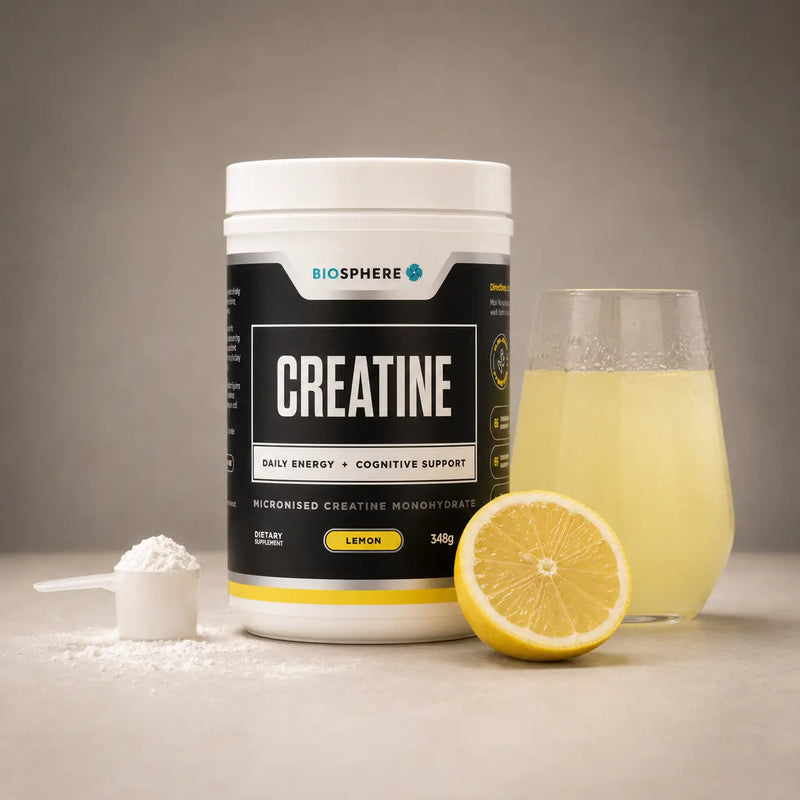
Biosphere Creatine
$0.93 a serving · 348g tub
- OptiCreatine™: micronised, so it dissolves properly with no grit
- GMP-certified facility, every batch third-party tested
- Naturally flavoured and sweetened with monk fruit and stevia. Sugar free, vegan and gluten free


Creatine is new
here. Biosphere isn't.
This is the ninth formula we've made, and every one is built the same way: the form with the best evidence behind it, at the amount the research used, tested by an outside lab and printed on the label where you can check it.
Creatine hasn't earned its own reviews yet, and we're not going to borrow any. What we can point you at is what people say about everything else we've made.
Sixty days, because a fortnight would tell you nothing.
Your reserve takes three to four weeks to fill, so we've set the window long enough to actually find out. Take it for sixty days, and if you decide it isn't doing anything for you, email us and we'll refund what you paid.
One email. That's the whole process.
The questions people actually ask
How long before I know if it's working?
Creatine isn't a stimulant, so there's nothing to feel on day one and there never will be. It works by filling the reserve your muscles and brain hold, which takes about three to four weeks of taking it daily. Most people describe the change as things feeling slightly less hard than they were, rather than as a moment. Give it a full month before you judge it.
Can I take it with my medication?
Creatine has a long safety record. A position stand reviewing the literature reports supplementation as safe and well tolerated across a wide range of people. It isn't suitable if you have kidney disease. If you take prescription medication or you're managing a health condition, check with your GP or pharmacist first, and drink plenty of water while you're taking it. Don't stop or change anything you've been prescribed.
I'm not doing any exercise. Is it still worth taking?
The memory research was done in people going about their lives, not in a gym, so that side doesn't depend on training. The muscle and bone research all ran alongside resistance work, so those benefits do. If you're carrying shopping, doing stairs, gardening or walking hills, that counts. You'll get more out of it the more you ask of your body, but you don't need a gym membership to start.
Will it bulk me up?
No. Building visible muscle takes sustained, deliberate training that nobody does by accident. What creatine does is fill a reserve your body already keeps, so the muscle you have works better rather than becoming larger.
Do I need to do a loading phase?
No, loading is optional. Taking several servings a day for the first five to seven days fills your reserve faster. One scoop a day gets you to the same place in about three to four weeks. Both routes end up in the same position, so take whichever one you'll actually keep up.
Is it suitable for my diet?
For most diets, yes. It's vegan, gluten free and sugar free, with no dairy, soy, eggs, nuts or shellfish. Creatine occurs naturally in meat and fish, so if you eat little or none of either, your natural stores are likely to be sitting on the lower side to begin with.
Why does this cost more than a plain tub of creatine?
Creatine monohydrate is the same molecule wherever you buy it, and we're not going to pretend otherwise. What differs is what was done to it and what was checked. Ours is single-sourced, water-washed and micronised, every batch is third-party tested with the certificate on file, and the scoop delivers the full amount the research was built on. Cheaper creatine may well do all of that too. The difference is that with this one you can check.
What if it's not for me?
Take it for 60 days. If you decide it isn't doing anything for you, email us and we'll refund what you paid. No form, no return shipping, no explaining yourself.


One molecule, and most of what you're trying to hold onto.
Memory, everyday energy, strength, bone. All of it runs off the same reserve, and one scoop a day is what keeps it full.
60-day money-back guarantee · Next-day Auckland dispatch