Your blood pressure
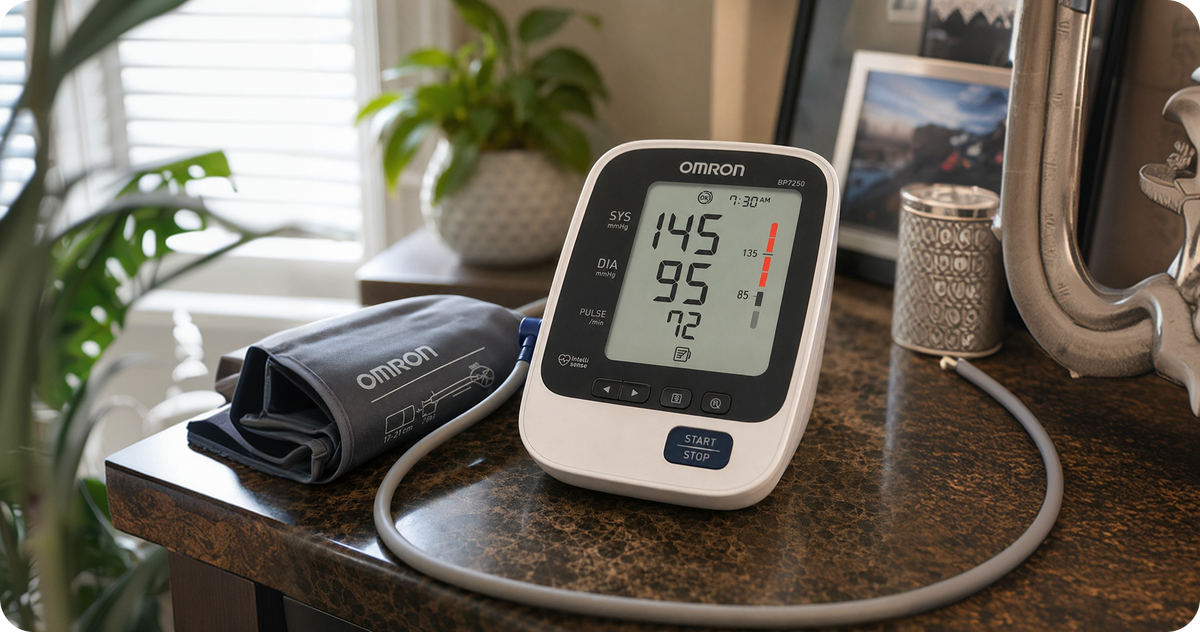
reading came back high.
There's a molecule that controls how easily blood moves through your body. Your body makes less of it every year.
- 60-day money-back guarantee
- Third-party lab tested

A problem has been put in front of you. So you're going to deal with it.
Your number came back high. The damage it represents has been building for years. Here's what that actually means. And why we're going to skip the part where we tell you to relax.
High blood pressure is called the silent killer for a reason. It doesn't hurt. It doesn't make you tired. You can walk around with dangerous numbers for years and feel completely fine. The damage builds quietly. Stiffer arteries. A heart working harder than it should. Pressure that compounds, not subsides, until something gives.
The number on your cuff is a warning. It's not the disease.
The disease is what high pressure does to your vessels, your heart, and your brain over the years that follow.
 Stroke risk
Untreated high blood pressure is the single largest contributor to stroke risk in adults.
 Heart disease
Among the strongest predictors of heart attack and heart failure in the over-50 population.
 Cognitive decline
Mid-life hypertension is associated with accelerated cognitive decline and higher dementia risk.


What you don't want is a lifetime on pills. What you do want is to take this seriously, do the work, and bring the number down the way it went up. Slowly. Properly. Without ignoring what the doctor said.
What we want to show you is something you've probably never heard of. Something your body has been making less of every year of your adult life.
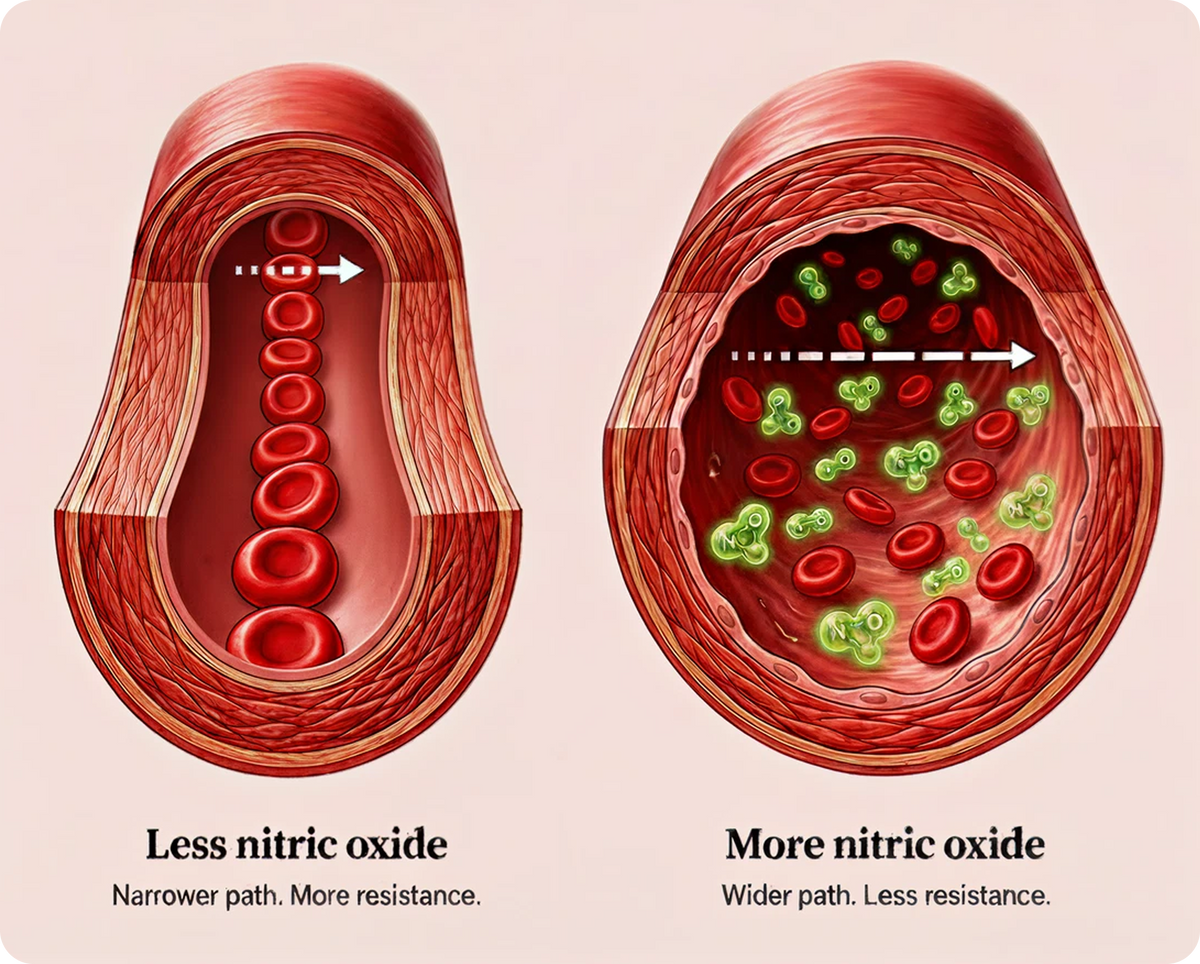
The reason has a name. You've probably never heard of it.
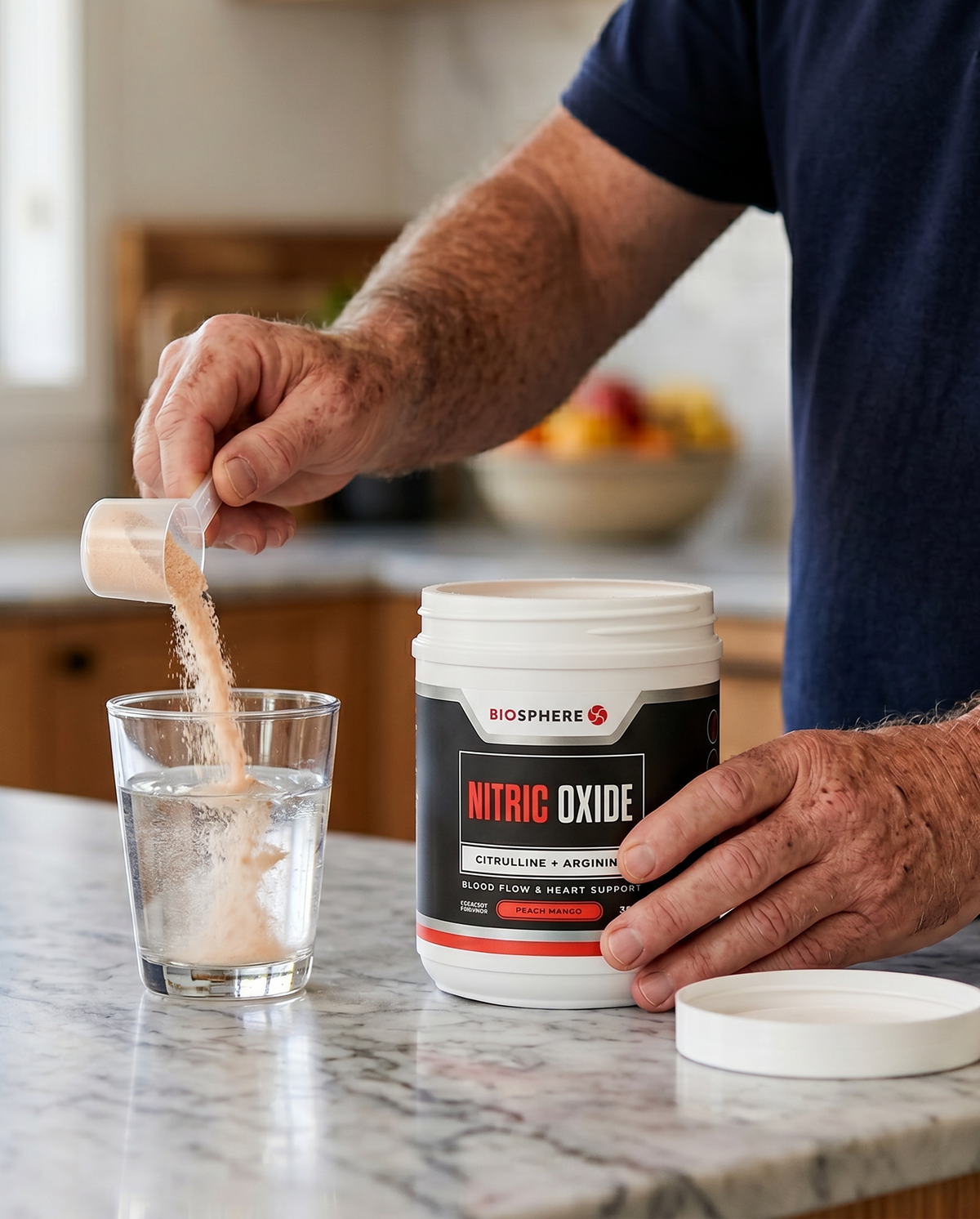
It's called nitric oxide. A molecule your body makes naturally. Its job is to tell your blood vessels to relax and widen, so blood moves through with less pressure.
Your body has been making less of it every year of your adult life. Less nitric oxide means stiffer, narrower vessels. Less room for the same volume of blood. The number goes up.
It's something your body does less of as you get older. The fix isn't to fight it. The fix is to support it.

THE SCIENCE IS SETTLED
In 1998, the Nobel Prize in Medicine was awarded for the discovery of nitric oxide.
The Nobel committee called nitric oxide "a completely new principle for signalling in biological systems."
Your nitric oxide production peaked in your twenties. It's been declining ever since.
In your 20s. Your baseline.
By your 60s. Around half what it was.
By your 70s. Less than half remaining.
The pharmaceutical world has been using nitric oxide for decades.
Viagra works by amplifying the same nitric oxide pathway. Vessels relax. Blood moves more easily. Same biology, different vessel system.
Nitroglycerin, the heart attack emergency drug under the tongue, works by releasing nitric oxide directly into the bloodstream. It's been used in cardiology since the 1800s. Doctors didn't know why it worked until 1998. They just knew it did.
What the drug industry doesn't advertise is that the building blocks your body uses to make its own nitric oxide are not pharmaceuticals. They're amino acids, herbal extracts, and vitamins. Available without a prescription. Not patentable. Not profitable for them to put on a billboard.
Why your GP didn't mention any of this.
It isn't a conspiracy. It's a workflow problem. A twelve-minute appointment. A confirmed diagnosis. A prescription pad. The system is built to manage the number on the cuff, not investigate why your body has stopped doing what it used to do on its own.
The pharmaceutical model trains around drugs that block, inhibit, or replace something. ACE inhibitors block an enzyme. Beta blockers block a receptor. Diuretics flush out fluid. They work. They also come with side effects, because they're forcing your body to do something other than what it naturally does.
Supporting your nitric oxide production is a different model. You're not blocking anything. You're giving your body the raw materials it used to have plenty of. The result, if you get the inputs right, is that your body does the work itself. Which is exactly what it was doing in your twenties when your blood pressure wasn't a problem.
WHAT IT ACTUALLY DOES TO THE NUMBER
A mechanism that sounds good on paper. And shows up on a blood pressure cuff.
In 2019, researchers pooled the results of twelve separate clinical trials on L-citrulline, one of the primary building blocks your body uses to produce nitric oxide. The combined finding: an average drop of around 7 mmHg systolic and 4 mmHg diastolic across the trials.
To put that in context. Cardiovascular research has spent decades tracking what happens to long-term stroke and heart disease risk when blood pressure drops by specific amounts. A reduction of 5 to 10 mmHg in systolic pressure is associated with roughly a 20% lower stroke risk and a 15% lower heart disease risk over the following years.
These aren't drug results. They're the results of giving people raw materials their body already uses. The body does the rest of the work.
The catch is the dose. Studies that produced these numbers used specific quantities of specific compounds. Beetroot juice will help. Leafy greens will help. A typical store-shelf supplement, formulated to a price point, usually won't get you to the threshold the research used. To replicate the result, you have to replicate the inputs.
Average drop in systolic pressure
The top number on your cuff. The one your GP circled.
Average drop in diastolic pressure
The bottom number. The pressure your vessels hold between beats.
Lower stroke risk at this scale of reduction
Based on long-running cardiovascular cohort data. ~15% lower heart disease risk.
Figures reflect pooled clinical trial outcomes and population-level cohort data. Individual results vary based on starting pressure, lifestyle, medication, and consistency of use.
Six ingredients at therapeutic doses.
One job.
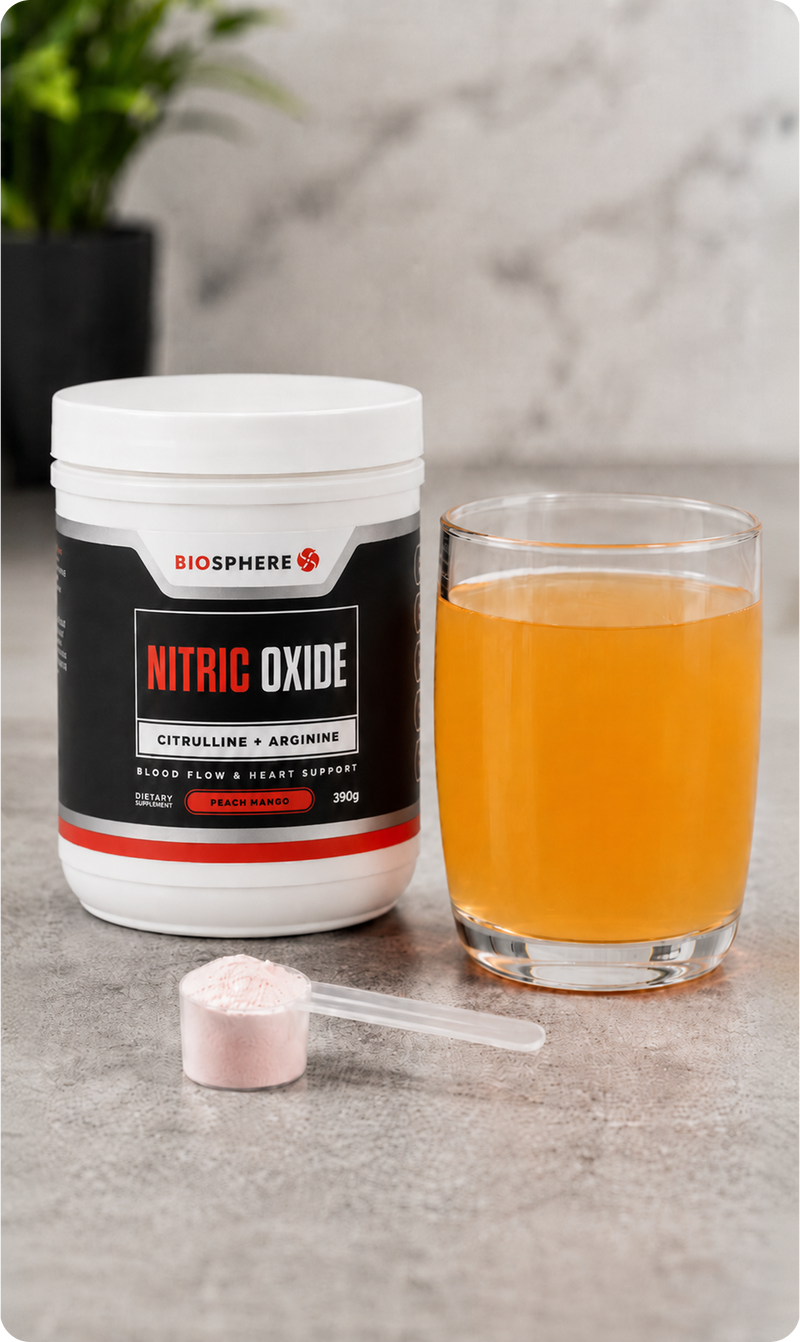
Six ingredients. Each chosen for a specific job in your cardiovascular system. Each at the dose used in clinical studies, where it actually showed a measurable effect. All printed on the label. Nothing hidden in a 'proprietary blend.'
- Primary Precursor2000mgL-Citrulline Malate
Converts to arginine, then to nitric oxide. Drives sustained production throughout the day.
- Direct Precursor1000mgL-Arginine
Direct nitric oxide precursor. Stacked with citrulline so the two work in tandem.
- Heart Muscle500mgTaurine
Supports heart muscle contractility and the electrolyte balance critical for healthy rhythm.
- 500mgHawthorn Berry Extract
A natural vasodilator. Used in herbal cardiovascular medicine for centuries.
- 300mgVitamin C
Protects nitric oxide from breaking down too quickly in the bloodstream.
- 200IUVitamin D
Enhances nitric oxide production in the inner lining of blood vessels.
Built for your heart, not the gym. Six ingredients at clinical-study doses. There are cheaper nitric oxide products in NZ. There are reasons they're cheaper.
The supplement industry runs on cheap forms, fractional doses, and good marketing.
Most products are formulated to a price point, not to a result. That's why most people don't feel anything when they take them.
Sourcing these six ingredients at therapeutic doses, one bottle each:
All six in one scoop. Twice daily. One tub.
- Six ingredients, full therapeutic doses
- USA-sourced, FDA-regulated manufacturing
- Third-party tested every batch
- 60 servings, 30 days at twice-daily use
- Naturally flavoured peach mango
- One ritual, twice a day
The strongest signal a supplement is working isn't a review.
It's a reorder.
72%
of Biosphere Nitric Oxide customers reorder within 90 days. People don't reorder a twice-daily product unless they're feeling the difference.
Customer Reviews
Overall rating: 4.8 / 5 from 1620 reviews.

Astaxanthin is vital for us all in this aging process. Every blessing we can get for all round health and optimal function is a bonus. We are grateful for the bioavailable source. Regards Steve and Fiona

I have tried many supplements over the years. Some I’ve stopped using because I didn’t notice a difference. I Will always aim to keep astaxanthin as part of my stack. I have noticed such an amazing change in my skin. My skin has always been good, but this has taken it to another level. I love this product! I particularly love the Biosphere brand as they use olive oil in the capsules, rather than seed oils. Really happy to support this NZ company.

Great product, I have been using it to help my eyes feel more comfortable ( post menopause) , they are definitely less scratchy than they were! I can’t wait to try the magnesium yet, it looks really good.

We both have the best sleep usimg this product. I am about to put in another order.

Lovely flavour and works really well.

I rely on 'Sleep' to help my sleep. Its a vial part of my evening ritual. I notice when I dont take it

Great for dry eyes. Best I've tried

Take this every night for restless legs and sleep . Alternate between the 2 flavours

Very good product but I did have to adapt it. I found taking it just before bed it would give me a hit of energy. So I no take it with dinner or just after around 7 and it gives my body time to process the ashwaganda. I still do have trouble sleeping but I do feel the nights I do sleep it’s a deeper sleep. I am going through a lot of stress and biological changes but I do feel it has helped just not as much as I hoped. The flavour is delicious and the customer service was awesome. I’m going to try the plain magnesium next time as I think ashwagandha not well suited to me

Great product - slept soundly :)

Love this product, after my first month I have far more mobility, energy and stamina, will be purchasing more...

I haven't gotten my very first bottle yet, but I will be ordering more. Capsules are easy to swallow, and makes it easy that need to take with food . Easy to remember with breakfast

On my second month of astaxanthin, not much change except a little more energy generally. Will give it a full three months.

I am so happy with my Astaxanthin . Can’t believe that it has worked so quick at pain relief . I have tried lots of other products in many years and I think this is the best thing I have tried . I have no pain and it so good . I hope this keeps up I have arthritis and and a few joint replacements so always in pain . Thank you

Awesome flavour magnesium for a massive day in the mountains!!!

Both flavours are nice and the powder mixes well. No longer getting night time cramps, so very happy with this. Will definitely be continuing with this product.

Awesome product.

I've been taking Biosphere Nitric Oxide for just over 5 weeks now. Before I started my blood pressure was in the 140s/150s/ 90s. This month I have only had one spike and my daily readings are consistently lower with some now in the ideal or normal range. I am really pleased with this result so far.

Ive been taking these now for a little over a month an just love the way my skin feels, an how its helped me not getting any flu this winter . As a shift worker doing 12 hr shifts I think its really been a great help getting me thru the day. I highly recommend them.

This magnesium is almost magic, I have had hip pain for several years and 5 weeks in it had totally gone. Unfortunately its a little hard on my stomach so have had to cut down the dose to half, I can just feel my hip pain a little again with the half dose. I will try supplementing the half dose with Astaxanthin next order.

I was getting regular muscle cramps at night and in the 30 days I trialled Biosphere Magnesium I only got a cramp once or twice. Since then I tried another brand of magnesium but haven't had the same success. Mixes easily and the lemon-lime flavour I tried us pleasant to drink.

I’ve been taking Bio sphere Nitric Oxide for a couple of years now as part of my supplement protocols. I workout at the gym and also do a lot of breathwork and this compliments everything I do.

It tastes good, easy to use, and I've halved my blood pressure tablet. It seems to be working for me and I intend to remove the blood pressure tablet totally in a week or so. It's coming on holiday with me!

Take it with my morning decaf that has coconut milk - so I am taking 2 capsules with some fats. Recently had people commenting on how nice my skin is looking. I am 60yo and recovering from cancer treatment.

Really happy with the magnesium powder, mixes well, tastes great and is now part of my daily routine.

Perfect start to my day…great flavour and definitely an improvement showing in my blood pressure levels!

The lemon/lime Magnesium powder is delicious and refreshing. It certainly is helping reduce cramps and helps me get to sleep quickly and sleep for longer periods.

I take magnesium after the gym to help with cramp.

Onto my first jar and already have a back up ready to go. Tastes delicious . Even bought a new bottle to use .

My husband is slowly reducing his blood pressure medication by using Nitric Oxide. Blood pressure is finally reducing

Been taking Astaxanthin for about 6 weeks now and definitely notice my eye and skin health is better, also seem to have a bit more energy.

A nightly routine, super power sleep when I take the magnesium - such a distinctly better sleep than nights I don’t take it.

I’ve recently changed to Biosphere Magnesium and will be reordering. It is so easy to take and adjust the amount as needed. I particularly like the Mango Pineapple flavour and take it just before bed to stop leg cramps.

Great product

I have this in the morning. Great tasting and refreshing. Great start to the day

I have found this the only product, after many years of finding something to help my sleep. My sleep for past 13 years been erratic due to menopause and hectic life. I have used this for a month now with only a couple of bad nights sleep. I sleep through until 5.00am. Hallelujah. Thank you Biosphere. Great product. Also just started using your hydrate supplement. I'll see how that goes over next month too.

I've been forgetting to wear my prescription glasses, it's been 3 months. My hair is a little darker, my nails are stronger and my skin has a summery glow. Hoping for some relief to my joints....

Easy to take and Good value for money!

The longer I take these the better I have been feeling

I started using astaxanthin on 13 May 2026. I live with chronic inflammation that often leads to headaches and migraines, and since beginning the supplement I’ve noticed a meaningful shift. My baseline inflammation feels lower, and the frequency and intensity of my headaches and migraines have reduced. Another unexpected change has been with my eye floaters. They used to be a daily nuisance, but over the past weeks they’ve improved noticeably. This is simply my personal experience and not a medical conclusion. Yet the changes have been significant enough for me to share.
WHAT THIS LOOKS LIKE IN PRACTICE
What ninety days of this actually feels like.
Most cardiovascular changes happen quietly. There's no dramatic moment. There's just a slow accumulation of small differences, until one day you check the cuff and the number looks different than it did before.
WEEK
01
You're mixing it morning and evening. It tastes like peach mango. You don't feel anything dramatic. That's normal. Your body is starting to do something it hasn't done at this scale in twenty years.
WEEK
03
Something feels different. Steadier energy through the afternoon. Hands and feet that don't go cold as easily. Recovery from a flight of stairs that comes back a bit faster. Most customers notice this stretch first.
WEEK
06
You check the cuff. The number is lower than it was last time. Not dramatically, not by twenty points, but lower. Enough to notice. Enough to bring up at your next GP appointment.
WEEK
12
You're not thinking about it anymore. It's just the scoop in the morning and the scoop at night. The number on the cuff has settled into a range you haven't seen in years. Your doctor has a question about what changed. You have an answer.
This isn't a guarantee of any specific number for any specific person. Bodies vary. Starting points vary. But this is the typical arc of what consistent twice-daily use looks like across a tub and a half.
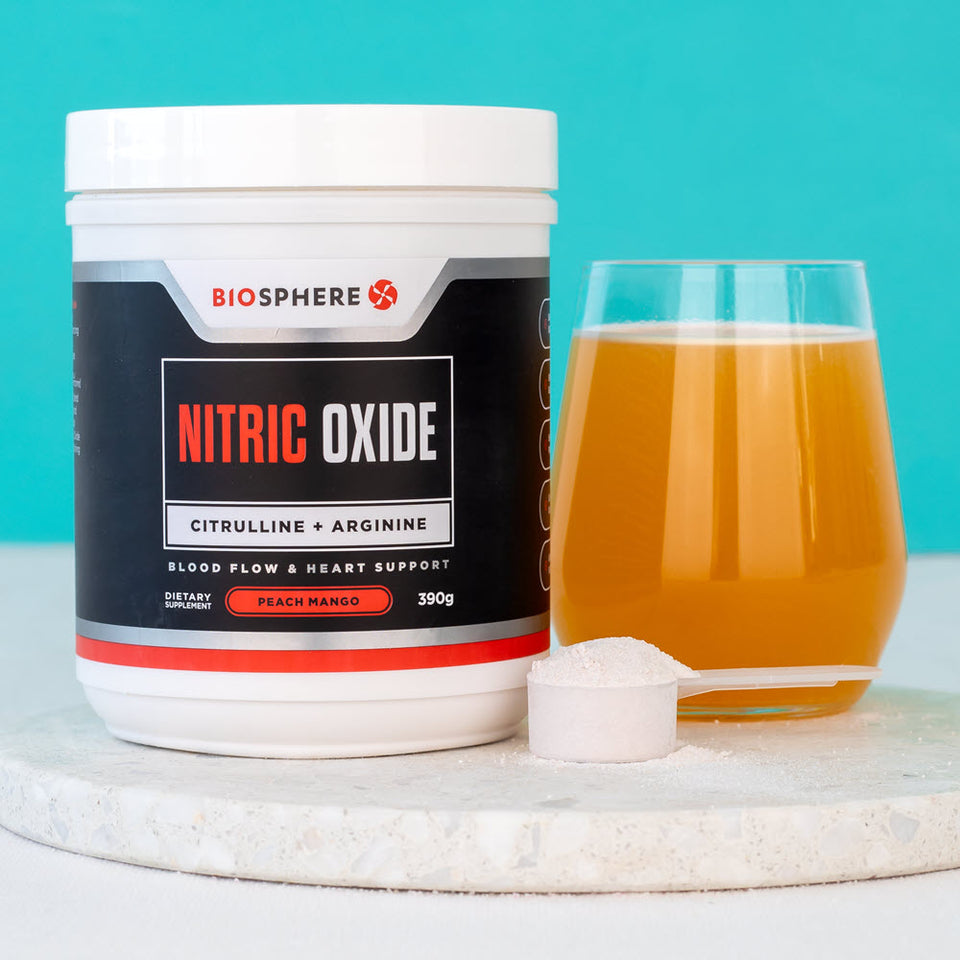
Biosphere Nitric Oxide
Less than $2.40 per day. NZD.
- Most customers notice changes within 2 to 4 weeks
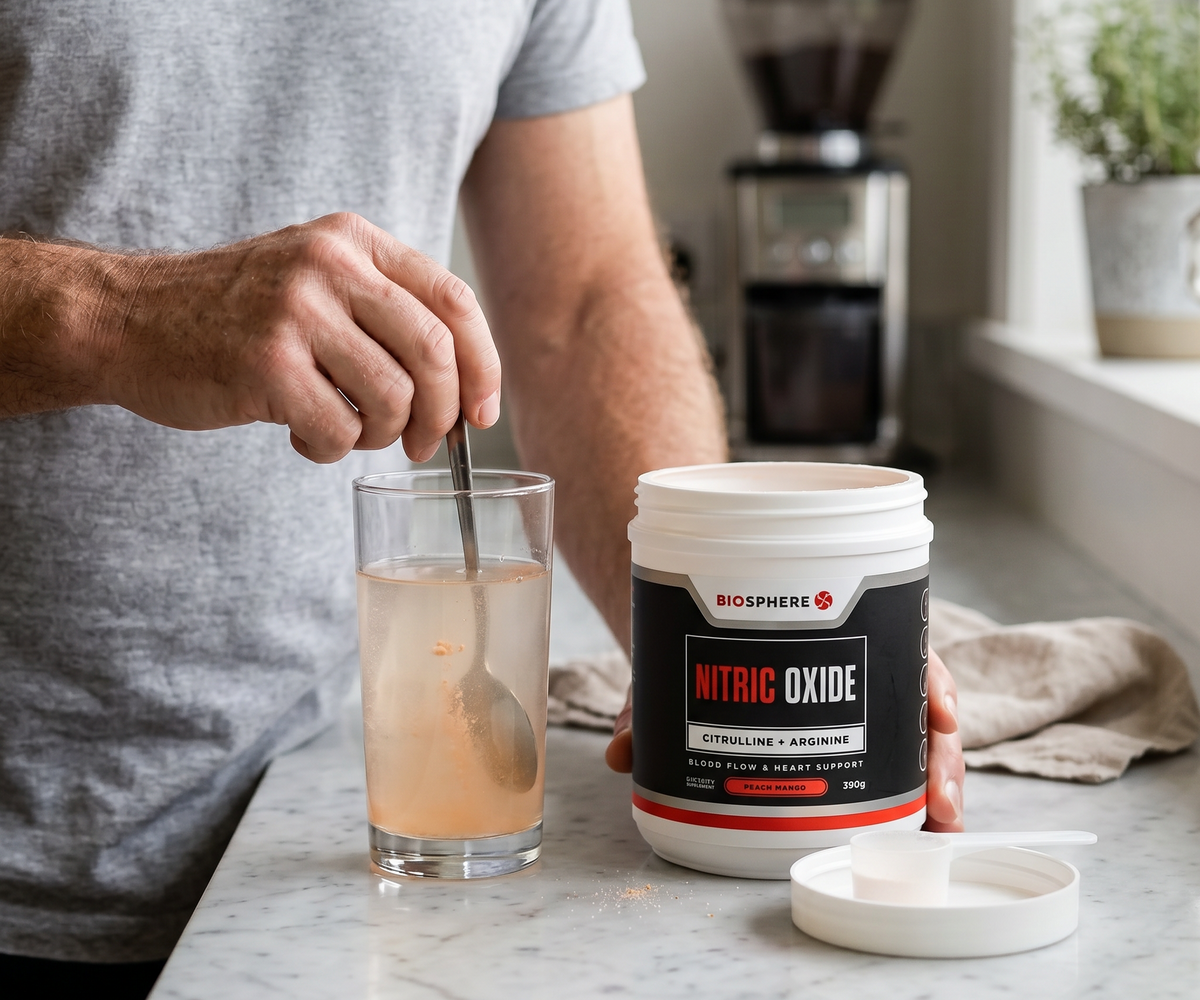
- 60 servings · one scoop in water, morning and evening
- Naturally flavoured peach mango. No fillers, no artificial sweeteners
- USA-sourced raw materials. Third-party tested every batch
 60-day money-back guarantee
Next-day Auckland dispatch
60-day money-back guarantee
Next-day Auckland dispatch


The only risk is not trying it.
Take it for 60 days. Morning and night, as directed. If you're not feeling steadier energy, better circulation, or seeing the number on your cuff start to move, we refund every dollar. No questions. No hoops.
You keep the tub either way. Whether you finish it and order another, or finish it and ask for a refund, the tub is yours. We're not in the business of asking customers to repackage a half-empty supplement and ship it back. If the formula isn't doing what we say it does, that's on us, not on you.

- No questions asked
- No need to return the tub. Keep it, finish it, or throw it out
- Full refund processed promptly via the original payment method
- Applies to every first-time purchase
What people ask before they try it.
How fast will I notice a difference?
Most people notice steadier energy and better circulation within 2 to 4 weeks of consistent use. Blood pressure changes take longer to register and depend on your starting point. Research suggests 4 to 8 weeks of consistent twice-daily use before changes typically become measurable. It works best when taken every day as directed, before meals.
Can I take this with my blood pressure medication?
If you are on prescribed blood pressure medication, please consult your GP before adding any supplement to your routine. Many customers use Biosphere Nitric Oxide alongside their medications with medical supervision, but a quick conversation with your doctor first is always the right call.
Is it safe to take long-term?
Yes. The ingredients are non-habit forming and well-researched for daily use. 72% of our customers reorder within 90 days, which suggests they are comfortable taking it as part of their ongoing daily routine.
How does it taste?
Naturally flavoured peach mango, sweetened with stevia. No artificial sweeteners, no synthetic flavours. Most customers describe it as pleasant enough to look forward to as a daily ritual.
Where does this ship from?
All Biosphere orders ship from our Auckland warehouse. Most orders are dispatched the next business day, with delivery to most parts of New Zealand within 1 to 3 working days from dispatch.
Everything you need. Nothing you don't.
- 1 tub of Biosphere Nitric Oxide · 60 servings (30 days at twice-daily dosing)
- 20% off your first order, no code needed
- Next-day Auckland dispatch on every order
- 60-day money-back guarantee, no questions asked